
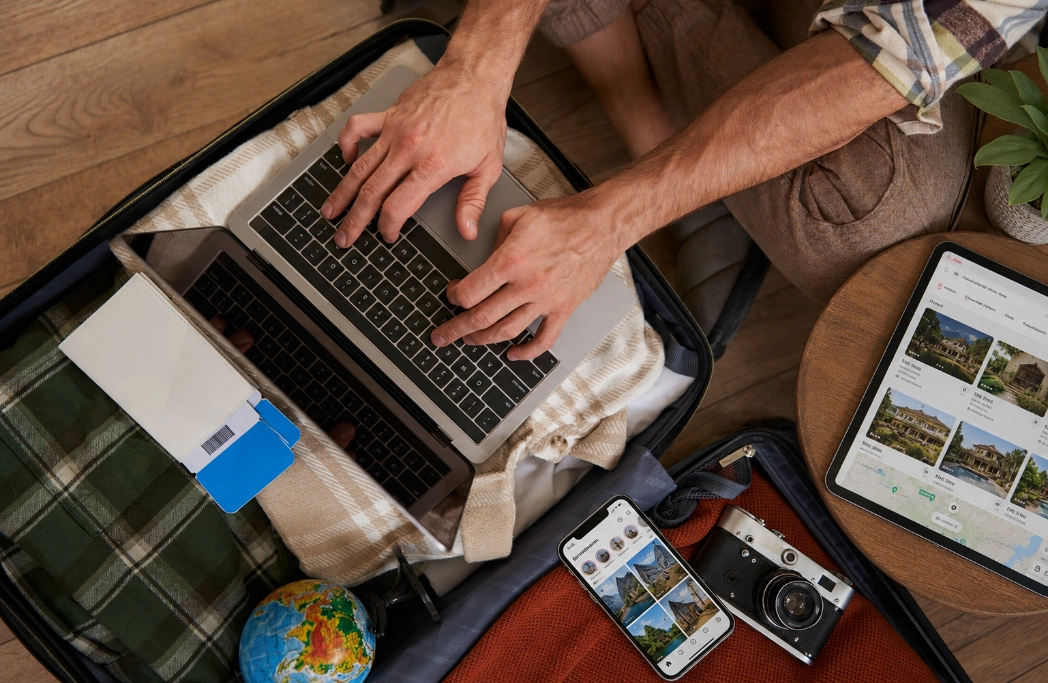
Travelers rarely move from inspiration to booking in a single straight line. Instead, they use different channels for different needs. Social media and videos tend to spark the idea, while search engines, AI tools, Google Maps, review sites, OTAs, and travel websites help them research destinations, compare options, and decide where to book.
So if you own a travel business, understanding this journey can help you show up where potential customers are looking.
In this guide, we’ll answer the question, “How do travelers search for destinations and experiences online?” Then, we’ll cover 10 things every travel business should know, along with practical ideas you can apply to improve your visibility and encourage more direct bookings.
A Quick Look at the Modern Traveler Search Journey
A single trip can involve half a dozen platforms before anyone books anything. A traveler might discover a destination on TikTok, research it on Google, compare experiences on an OTA, check reviews on Google Maps, and then return to the business’s website to book directly.
Along the way, that journey almost always includes:
- Multiple devices and sessions: Researching on a phone on the couch, a laptop at work, and a tablet before bed.
- Repeated comparison: Revisiting the same options several times before making a decision.
- Changing destinations or plans: Adjusting the itinerary as they discover new ideas or better options.
- Movement between inspiration and practical research: Dreaming about a trip one moment, then checking prices, opening hours, or travel times the next.
- Returning to earlier channels before booking: Going back to a review, a video, or a website they visited days earlier.
10 Useful Takeaways About How Travelers Search Online
From the first travel idea to the final booking, travelers search with different goals in mind. Here are 10 things every travel business should know about how people search online today:
1. Travelers Begin with Inspiration

Long before anyone has a firm plan, they’re collecting ideas. This early stage is about discovering their destination, not decisions, and it usually starts somewhere visual.
Social Media and Short-Form Video
Social media is often where travelers discover new destinations and experiences. Photos, short videos, and content from creators or other travelers help people picture themselves taking the trip before they start planning the details.
At this stage, they use these channels to:
- Discover travel destinations they haven’t heard of before.
- Find authentic experiences that match their interests.
- Get ideas for future trips.
- Save posts and videos to come back to later.
Friends, Family, and Online Communities
Personal recommendations still carry more weight than almost any ad. A suggestion in a group chat, a conversation with someone who’s already visited, or a discussion in an online community can inspire an entire trip and lead travelers to start researching on their own.
Many people also turn to forums, Reddit, Quora, Facebook groups, and other travel communities to ask questions and learn from other travelers’ experiences.
Travel Blogs, Publications, and Destination Content
Travel blogs, destination websites, and online publications help travelers go beyond the highlights they see on social media. They offer practical travel information, suggested itineraries, seasonal travel tips, and local recommendations that make it easier to decide whether a destination or experience is the right fit.
That’s an important opportunity for travel businesses. Expedia Group found that 63% of vacation rental bookers hadn’t chosen a specific destination when they first decided to take a trip. Showing up with helpful, inspiring content early in the journey can influence where travelers decide to go.
2. Travelers Use Search Engines to Research Their Options

Once interest exists, the questions get more specific. This is where a browser becomes the traveler’s planning tool, with searches like:
- Best places to visit in Italy
- Things to do in Monteverde
- Best time to visit Japan
- Where to stay in La Fortuna
- Is Costa Rica safe?
- How many days do you need in Iceland?
- Family-friendly activities in Orlando
- Best tours in Machu Picchu
Broad Destination Searches
Early on, searches are wide and evaluative. Travelers are simply trying to decide whether a destination is even a good fit for them before investing more time in it.
Practical Planning Searches
Once a destination makes the shortlist, the questions turn logistical: weather forecasts, driving times, entrance fees, parking, public transportation, accessibility, and opening hours.
Experience-Specific Searches
Finally, attention narrows to what they’ll actually do: walking tours, museums, zipline adventures, food tours, cultural experiences, and local events. This is the stage where genuinely useful content can move a traveler from curiosity to serious consideration.
3. AI Tools Help Travelers Explore and Organize Ideas

AI tools like Claude, ChatGPT, and Gemini have become another part of the travel planning process. Travelers use them to ask conversational questions, compare destinations, build itineraries, and narrow down their options, with prompts like:
- Where should I go for a five-day family trip?
- Plan a weekend itinerary in Italy.
- What are the best outdoor activities near Denver?
- Compare Monteverde and La Fortuna for adventure travelers.
It’s worth being clear-eyed about this: AI isn’t replacing traditional search. Travelers still verify AI-generated answers through Google, Maps, reviews, and direct websites. Think of it as one more research layer; a fast way to organize thinking that still gets fact-checked against everything else.
Like search engines, AI tools help travelers move from broad ideas to more informed decisions—but they’re usually just one stop along the way.
4. Google Maps and Local Search Help Travelers Find Nearby Experiences

After using Google to research a destination, many travelers turn to Maps before and during their trip. Often with a phone in hand, they use it to compare nearby options and decide where to go next.
Travelers rely on it for:
- Near me searches
- Location-based activity searches
- Opening hours
- Directions
- Photos
- Reviews
- Business categories
- Calling to ask about availability or opening hours
- Visiting the business’s website to check pricing or book directly
That’s why it’s so important to keep your Google Business Profile accurate and up to date. If your hours, business category, photos, or location are missing or outdated, travelers may choose another business that provides the information they’re looking for. A complete profile also gives your business a better chance of appearing in relevant search results when travelers are ready to explore or book.
5. Reviews and User-Generated Content Help Travelers Validate Their Choices

Before committing, travelers look for reassurance that they’re making the right choice. They gather it from Google reviews, TripAdvisor, OTA reviews, social media comments, traveler photos and videos, testimonials on business websites, and increasingly, review summaries generated by AI tools.
What travelers look for in reviews
They’re not just skimming star ratings. They’re scanning for specifics:
- Whether the experience matches the description
- Quality of service
- Whether the experience felt safe, well organized, and started on time
- Whether the experience felt worth the price
- Cleanliness
- Whether the experience is suitable for travelers with mobility needs.
- Suitability for families or specific traveler types
- How the business handles problems when they come up
Authentic reviews reduce uncertainty. The more clearly a traveler can picture themselves having a good experience, the more confident they feel booking it.
6. Travelers Compare Destinations and Experiences Across Multiple Websites

Travelers almost never evaluate an option in isolation. During the planning phase, they weigh it against alternatives, usually across several open tabs. What they compare often depends on their trip type, but common factors include:
- Price and overall value
- Location
- Availability on their travel dates
- Reviews
- Photos and videos
- What’s included (transportation, meals, entrance fees, or equipment)
- Duration (two hours, half day, or full day)
- Cancellation flexibility (free cancellation or non-refundable)
- Ease of booking
- Brand credibility
- Unique features that set one option apart
The option that presents this information most clearly often wins, not necessarily the cheapest one.
7. OTAs Make It Easier to Compare Options

Online travel agencies (OTAs) are a popular online resource during the planning phase. Whether travelers are comparing hotels, flights, rental cars, tours, or attractions, they often use OTAs to research their options—even when they don’t end up booking there.
They make it easy to compare:
- Real-time availability for selected dates
- Reviews from previous travelers
- Prices
- Cancellation policies
- What’s included
- Different experiences in the same destination
OTAs also offer a familiar booking process, making it quick and easy to compare multiple options in one place.
That doesn’t mean they’ll always get the booking. Travelers often visit a business’s website before making a final decision. If your website provides clearer information, builds trust, and offers an easy booking experience, they’re more likely to book directly.
8. Travelers Visit Direct Websites Before Making a Final Decision

For many travelers, a business’s website is the final credibility check before they book. They come looking for:
- More complete details about the experience, meeting point, and what’s included
- Official pricing
- Real-time availability
- Direct booking benefits
- Cancellation policies
- Real photos that show what travelers can expect
- Safety information
- FAQs
- Contact options like WhatsApp, email, or phone
- Proof that the business is legitimate and responsive
This is also where bookings are won or lost. If your website loads slowly, is difficult to navigate on a mobile device, or makes it hard to find key information, travelers may return to an OTA or choose another business that makes booking easier.
Not sure how your website is performing? Google’s PageSpeed Insights is a free tool that can help you identify performance issues and opportunities to improve speed and usability.
9. Mobile Experience Matters for Research and Booking Decisions

60% of travel research and booking now happens on a phone, often while travelers are already at the destination and deciding what to do next. If your website isn’t easy to use on a mobile device, they may leave before they ever reach your booking page.
Here’s what travelers expect from a mobile-friendly website:
- Fast-loading pages: Google recommends keeping your Largest Contentful Paint (LCP) at 2.5 seconds or less as part of its Core Web Vitals. If your main content takes too long to load, travelers may leave before they even see what you offer.
- Mobile-friendly navigation: Visitors should be able to reach important pages like your tours, pricing, FAQs, and booking page in just a few taps. Menus should be easy to open, and links and buttons should be large enough to tap without zooming in.
- Easy-to-read content: Use short paragraphs, clear headings, readable font sizes, and enough spacing between sections. Travelers should be able to quickly scan your page and find the information they need.
- Click-to-call options: Make your phone number tappable so travelers can call with one tap instead of copying and pasting it into their phone.
- Simple booking forms: Ask only for the information you need, such as the tour, preferred date, number of guests, and contact details. Long forms with unnecessary fields can lead travelers to abandon the booking.
- Clear buttons: Calls to action like Book Now, Check Availability, Get Directions, or Contact Us should be easy to spot and large enough to tap on a phone.
- Mobile payment: Offer a secure checkout that works smoothly on mobile devices, whether travelers are paying with a credit card or a digital wallet.
- Maps and directions: Let travelers open your location directly in Google Maps with a single tap, making it easy to find your business without copying and pasting an address.
10. Travelers Book When They Find Trust, Value, and Convenience

Getting found online is only the first step. Travelers book when they stop asking questions and feel confident enough to move forward. That means that every piece of information on your website should help them make that decision.
Before they book, they usually check whether you:
- Explain what makes the experience worth the price, not just what it costs.
- Show recent reviews that reflect real customer experiences.
- Clearly list what’s included, such as transportation, entrance fees, meals, equipment, or a guide.
- Display transparent pricing, with no unexpected fees during checkout.
- Show availability for the dates and times they want.
- Offer flexible cancellation or rescheduling policies in case their plans change.
- Make booking quick and easy, without requiring unnecessary steps or information.
- Provide secure payment options that travelers recognize and trust.
- Use real photos and accurate descriptions that match the experience they’ll have.
- Give travelers a clear reason to choose you, whether that’s smaller groups, expert local guides, exclusive access, or another unique benefit.
What You Should Do at Each Stage of the Search Journey
Here’s how to show up with the right content at each stage of the traveler journey:
During Inspiration
Create visual content that helps travelers picture themselves there. Focus on social media, destination storytelling, authentic photos, and videos that showcase the experience.
During Research
Answer the questions travelers are already searching for. Publish SEO content, destination guides, practical FAQs, itineraries, and planning resources that help them make informed decisions.
During Validation
Build trust with recent reviews, testimonials, traveler photos, detailed information, and clear trust signals that reassure travelers before they book.
During Comparison
Make it easy to compare your experience with others. Clearly explain your pricing, what’s included, cancellation policies, unique selling points, and direct booking benefits.
During Booking
Remove every point of friction. Make sure your website loads quickly, works well on mobile, shows real-time availability, offers secure payment, and makes it easy to book with clear calls to action.
How to Measure Where Travelers Find and Choose You
The channel that inspires a traveler isn’t always the one that gets the booking. Someone might discover your business on Instagram, read one of your blogs through Google a few days later, check your Google Business Profile before their trip, and finally book by typing your business name into Google.
To understand what’s really driving bookings, look beyond last-click attribution and track:
- Organic search traffic: How many visitors find your website through search engines.
- Social referral traffic: How many visitors arrive from platforms like Instagram, Facebook, TikTok, or YouTube.
- Branded searches: How often people search for your business by name, showing that previous marketing efforts are creating awareness.
- Google Business Profile actions: Website visits, phone calls, direction requests, and other actions people take from your Business Profile.
- Assisted conversions: Channels that helped influence a booking, even if they weren’t the final source before the purchase.
- Repeat visits: How often travelers come back before making a decision.
- Booking page engagement: Whether visitors reach your booking page and spend time there instead of leaving immediately.
- Inquiry and booking sources: Which channels generate contact form submissions, phone calls, WhatsApp messages, or completed bookings.
- Top content paths: The pages travelers visit before reaching your booking page.
- Direct booking conversion rate: The percentage of website visitors who complete a booking on your website.
Looking at these metrics together gives you a much clearer picture of how travelers move from inspiration to booking. It also helps you understand which channels are building trust and influencing decisions, even if they don’t receive the final click.
Common Gaps That Can Make Your Tourism Brand Harder to Find Online

If travelers aren’t finding or choosing your business, one of these gaps may be holding you back. The good news is that many of them are fixable.
Start by checking whether any of these apply to you:
- You’re focusing on only one channel: Travelers move between social media, search engines, Google Maps, AI tools, OTAs, and direct websites. Relying on just one channel means missing opportunities to connect with them throughout their journey.
- Your content promotes your business but doesn’t answer travelers’ questions: Travelers search for practical information like things to do, the best time to visit, itineraries, pricing, and what to expect—not just promotional content.
- You’re overlooking local SEO and your Google Business Profile: An incomplete or outdated profile can make it harder for travelers to find your business in Google Search and Google Maps when they’re ready to book.
- You have few or outdated reviews: Recent reviews, traveler photos, and thoughtful responses help build trust and reassure potential customers.
- Your destination content looks like everyone else’s: Generic content rarely stands out. Travelers are more likely to engage with local insights, practical tips, and unique experiences they can’t find elsewhere.
- Your website doesn’t work well on mobile: Slow-loading pages, difficult navigation, small buttons, or long booking forms can discourage travelers from completing a booking.
- Your booking pages leave important questions unanswered: Make it easy to find pricing, availability, what’s included, meeting points, cancellation policies, and FAQs before asking travelers to book.
- Your business information isn’t consistent: Different opening hours, phone numbers, addresses, or website links across platforms can confuse travelers and reduce trust.
- Booking directly is harder than booking through an OTA: If your website requires more steps, provides less information, or creates friction during checkout, travelers may choose the easier option.
- You’re only measuring the last click: Looking only at the final booking source can hide the channels that inspired travelers, built trust, and influenced their decision along the way.
Meet Travelers Wherever Their Search Journey Takes Them
You don’t need to dominate every platform to grow. What you need is a coordinated SEO strategy that helps travelers find useful, consistent information across the channels that matter most, from the first spark of inspiration to the final tap on “book.”
That’s the work we at Nativo focus on: tourism SEO, content strategy, website optimization, local search, paid campaigns, social media, and conversion strategy, all backed by performance tracking that shows what’s actually driving bookings.
If you’re ready to build a digital strategy around how travelers really discover, compare, and book, contact Nativo today and let’s talk about where your journey has the most room to grow.