
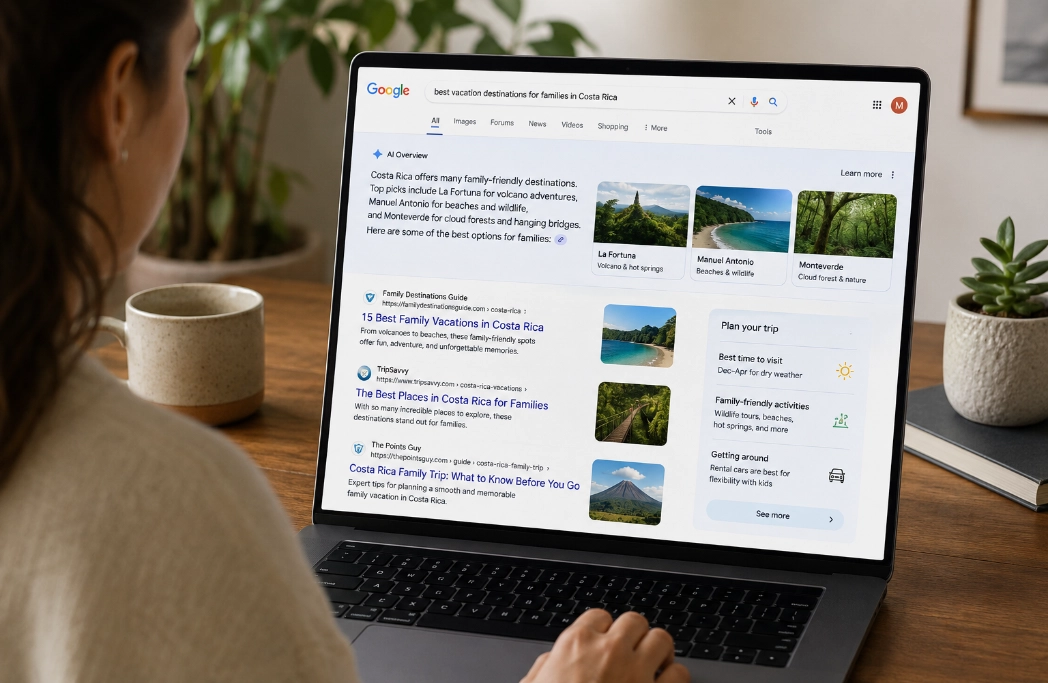
AI Overviews now answer many travel questions directly in Google’s search results, linking out to just a handful of supporting sources. That’s changing how travelers discover destinations, compare experiences, and decide which websites to visit.
If your tourism business relies on Google search to attract travelers and generate bookings, you’re probably wondering what this means for your website. Will AI Overviews reduce your traffic? Should you rethink your SEO strategy? Does traditional SEO still matter?
The short answer is yes: traditional SEO still matters but you need to adapt how you create, organize, and measure your content.
In this blog, we’ll explain how AI and Google AI Overviews impact tourism SEO, what it means for your traffic and bookings, and what you can do to stay visible in Google Search.
Get a Free ConsultationWhat Are Google AI Overviews?

Google AI Overviews are AI-generated summaries that Google may display for searches that require an explanation, a comparison, or information from multiple sources. Instead of showing only a list of webpages, Google may first generate a summary that combines details from several sources and includes links to supporting websites.
How AI Overviews Differ From Traditional Search Results
A traditional Google search results page is mostly a list of webpages ranked by relevance. AI Overviews work differently by displaying a summarized answer before the regular organic results. Those listings don’t disappear—they still appear on the same page—but travelers may find the information they need before clicking through to a website.
How AI Overviews Differ From Featured Snippets
Featured snippets have been part of Google Search for years, but they usually highlight information from a single webpage to answer one question. AI Overviews are different because they can combine information from several sources into a single response while linking to supporting websites.
Why Travel Searches Are Well Suited to AI Overviews
Travel planning rarely comes down to one simple question. Travelers often compare destinations, consider the best time to visit, evaluate transportation options, set a budget, and choose activities that match their interests—all before making a booking. AI Overviews are designed to answer these multi-part questions by bringing together information from multiple sources.
For example, a traveler might search:
- Is Rome or Florence better for a first trip to Italy?
- What should I do in Tokyo during four rainy days?
- Which Hawaiian island is best for families?
- Can I visit Paris and Versailles on the same day?
These aren’t simple keyword searches; they’re travel planning questions. That’s why tourism businesses need content that answers the complete question, not just the keyword.
How Is AI Changing the Way Travelers Search?

Travelers are no longer running several short searches to piece together an answer. Rather, they’re asking one detailed, conversational question and expecting a complete response. As a result, tourism SEO strategies need to shift from targeting a single keyword to addressing the entire decision a traveler is trying to make.
Here are three ways AI is changing how travelers search and plan their trips:
Travelers Are Asking Longer and More Specific Questions
Many travel searches now include personal circumstances, such as:
- What are the best things to do in London with teenagers in winter?
- Where should I stay in Barcelona without renting a car?
- Is Iceland suitable for older travelers with limited mobility?
- What can I do in New York City on a moderate budget?
The most helpful tourism content answers the main question while also covering the concerns that naturally influence the decision, such as budget, mobility, weather, transportation, or the type of group traveling. That gives travelers the information they need without requiring multiple searches.
Travelers Can Compare Several Options in One Search
Travelers can now ask Google to compare destinations, tours, transportation options, seasons, or neighborhoods in a single search. This increases the value of comparison pages that go beyond listing pros and cons by clearly explaining which option is the best fit for different types of travelers.
More Travel Research May Happen Inside Google
For simple, factual questions, some travelers may find everything they need in an AI Overview without visiting a website.
Tourism businesses therefore need to offer more than basic information. Original recommendations, local expertise, practical planning advice, and booking resources give travelers a reason to continue to the website.
How Do AI Overviews Affect Tourism Website Traffic?

AI Overviews don’t affect every type of search in the same way. Some pages may receive fewer clicks because Google answers simple questions directly in the search results, while others may gain visibility by being included as supporting sources.
See where this plays out for your website’s organic traffic:
Basic Informational Content May Receive Fewer Clicks
Simple informational queries are often straightforward enough for Google to answer directly in an AI Overview.
For example:
- Average weather in Paris in October
- Flight time from New York to London
- Currency used in Japan
- Best month to visit Bali
When Google answers these informational user queries directly in the search results, fewer travelers may visit a website for that information. For that reason, you shouldn’t rely heavily on articles that repeat facts available across dozens of other websites.
Detailed Tourism Content May Gain New Visibility
Pages that answer specific travel questions in depth are more likely to be referenced as supporting sources.
Examples include:
- Accessible attractions in Rome
- Winter driving tips for Iceland
- Family-friendly safaris in Kenya
- Train travel between cities in Switzerland
- Visiting Dubai during Ramadan
These topics help travelers make decisions or prepare for their trip rather than simply providing general information. That’s the type of content AI Overviews are more likely to reference when answering complex travel questions.
Click Quality May Become More Important Than Click Volume
Someone who clicks through after reading an AI Overview may already understand the basics and be comparing providers, checking availability, or getting ready to book.
Because of this, tourism businesses should evaluate more than total organic search traffic. Bookings, inquiries, availability checks, and other actions that show buying intent often provide a clearer picture of SEO performance.
Traffic Changes Will Depend on Search Intent
Not every search has the same purpose. Informational searches are more likely to be answered directly in Google, while commercial searches still require travelers to visit a business’s website.
For instance, “What is the best time to visit Greece?” may generate fewer clicks than “Book a private Santorini sunset tour,” where travelers still need to compare options, check pricing, and make a reservation.

How Do AI Overviews Affect Tourism Search Visibility?
Tourism website appearing both in traditional Google results and as a supporting source in an AI Overview.
AI Overviews affect tourism search visibility by creating new opportunities for websites to appear in Google Search. Instead of competing only for a top organic ranking, tourism websites may also be selected as supporting sources within an AI-generated answer.
According to Google, AI Overviews can surface a wider variety of helpful links and create opportunities for more types of sites to appear in search results.
These are three ways AI Overviews affect tourism search visibility:
AI Overviews Can Surface Sources Beyond the Top Result
Ranking first in the traditional search engine results is still valuable, but it’s no longer the only way websites can gain visibility. Google AI Overviews can bring together information from multiple sources to answer a complex question, creating opportunities for niche tourism content that provides clear, relevant answers to specific travel questions.
Specialized Pages Can Support Broader Travel Questions
Take a search like “What should I know before taking my family to Japan in July?” Google may look for supporting information across several topics, including:
- Summer weather
- School holiday crowds
- Heat precautions
- Family attractions
- Transportation
- Regional festivals
Your tourism business doesn’t need to answer every part of the question. A highly relevant page covering one of these topics may still be included as a supporting source within the AI Overview.
Tourism Brands Face More Source Competition
Depending on the search, AI Overviews may include information from tourism boards, tour operators, hotels, travel publications, forums, review websites, and video content. As a result, tourism businesses compete with a wider range of sources than they do in the traditional search results.
The way to stand out isn’t to publish more content than larger websites. It’s to publish information that’s more specific, practical, and difficult to find elsewhere—something generic travel websites and large publishers don’t cover in depth.
What Types of Tourism Content Are Most Affected?
AI Overviews don’t affect every type of tourism content equally. Pages that answer broad informational questions may face more competition, while content that helps travelers plan and make decisions can continue to attract qualified visitors.
The following content types are most likely to be affected by AI Overviews:
Destination Guides
Broad destination guides often cover information travelers can find on many websites, making them easier for AI Overviews to summarize. To stand out, your guides should go beyond the basics by including firsthand recommendations, geographic context, practical planning tips, and clear links to your tours, accommodations, or other relevant services.
Travel Itineraries
Travel itineraries remain useful when they help travelers build a realistic plan. Include travel times, transportation options, the best order to visit attractions, booking requirements, and alternative suggestions if plans change.
On the other hand, simple lists of attractions without practical planning details are easier for AI Overviews to summarize without generating a click.
Comparison Articles
Comparison articles help travelers decide which option best fits their trip. Consider creating content that compares:
- Destinations
- Tours
- Neighborhoods
- Seasons
- Transportation options
- Guided and self-guided experiences
The most useful comparison pages don’t just explain the differences. They help travelers understand which option is the best fit for their budget, travel style, or interests.
Seasonal Travel Content
Many travelers search for seasonal information before they book a trip. Weather, crowds, wildlife, prices, festivals, and travel conditions can all influence their decision.
Review these pages regularly to keep dates, recommendations, and local conditions accurate. Updated information is more helpful for travelers and more valuable to Google.
Practical Planning Content
Practical planning content answers the questions travelers ask before they book or arrive. Accessibility, transportation, parking, what to wear, age requirements, safety, tour duration, and booking policies all help travelers make informed decisions.
This is where your business has an advantage. You know the questions your guests ask every day, so you’re in the best position to provide accurate, experience-based answers that other websites may not have.
How Should Tourism Businesses Adapt Their SEO Content?

The goal isn’t to create content specifically for AI search. It’s to publish information that’s more helpful, more specific, and more trustworthy than a basic AI-generated summary.
See how you can adapt your tourism content for both travelers and Google:
Go Beyond Information Travelers Can Find Anywhere
Cut generic statements and add details that only come from real experience running your business, such as:
- Realistic travel times
- Common guest questions
- Seasonal changes
- Tour suitability
- Local transportation advice
- Accessibility limitations
- What visitors frequently misunderstand
This is the kind of information travelers won’t find on every website, making your content more useful and more difficult to replace with a generic AI summary.
Answer the Complete Search Intent
A page should satisfy the full user intent, not just answer the main question. For example, an article about the best time to visit Thailand should also cover regional weather, crowds, prices, festivals, and the activities best suited to different times of the year.
Focus on what’s connected to the traveler’s decision rather than expanding into unrelated topics just to increase word count.
Add Firsthand and Original Information
Bring in insights from people who know the destination best, including:
- Local guides
- Tour operators
- Hotel teams
- Destination specialists
- Drivers
- Naturalists
- Previous guests
Original photos, maps, itineraries, comparison tables, and local recommendations are details an AI summary simply can’t replicate.
Give Travelers a Clear Reason to Click
Offer something an AI summary can’t deliver, such as:
- Detailed itineraries
- Interactive maps
- Live availability
- Current pricing
- Downloadable guides
- Original videos
- Personalized recommendations
- Direct booking options
These resources help travelers move from research to planning and booking while giving them a reason to continue exploring your website.
Keep Travel Information Updated
Review your content regularly to make sure information such as the following stays accurate:
- Prices
- Opening hours
- Tour inclusions
- Seasonal schedules
- Transportation details
- Entry requirements
- Policies
- Booking links
Outdated information can erode both search visibility and traveler trust.
Does Traditional Tourism SEO Still Matter?

Yes. AI Overviews don’t replace traditional tourism SEO. Before your content can appear in traditional search results or AI-powered search features, Google still needs to discover, crawl, understand, and evaluate your pages. In other words, the same SEO fundamentals continue to matter.
Check out the SEO fundamentals that continue to support your visibility in Google Search:
Technical SEO Remains the Foundation
Technical SEO helps search engines access and understand your website. That includes making sure your pages are crawlable and indexable, load quickly, work well on mobile devices, use clear internal links, have a logical site structure, and are served over a secure connection (HTTPS).
Without these foundations, your content may struggle to appear in both traditional search results and AI-powered search features.
Want to learn more about this topic? Check out our guide: How Does Technical SEO Affect Tourism Websites?
Keyword Research Still Reveals Traveler Intent
Keyword research is still one of the best ways to understand how travelers search for destinations, activities, concerns, and booking information. Rather than focusing only on exact-match keywords, use your research to identify the broader topic and the related questions travelers want answered.
This approach helps you create content that satisfies user intent instead of targeting a single phrase.
On-Page SEO Helps Search Engines Understand Your Content
Clear page titles, descriptive headings, logical page structure, descriptive internal links, optimized images, and accurate metadata all help search engines understand your content.
These elements also make it easier for Google to identify the topics your pages cover and present them in the appropriate search results.
Internal Links Connect Travel Research With Booking Pages
Informational content shouldn’t exist on its own. Guide travelers from research to booking by linking related articles to relevant destinations, tours, accommodations, transportation pages, or other services.
For example, if you publish a guide about visiting Iceland in winter, link naturally to your northern lights tours, transportation information, accommodation recommendations, or booking pages. These connections help both travelers and search engines navigate your website more effectively.
How Can Tourism Websites Improve Their Chances of Appearing in AI Overviews?
No tactic guarantees inclusion in an AI Overview. The best approach is to make your pages easy to access, understand, and trust. In fact, according to Google, there are no special optimizations or markup designed specifically for AI Overviews.
With that in mind, check out the best practices that can improve your chances of appearing in AI Overviews:
Make Important Pages Crawlable and Indexable
Make sure search engines can access your destination pages, tour pages, travel guides, and key service information. It sounds basic, but it’s one of the most common reasons important pages don’t perform as expected.
Use Clear and Descriptive Page Structures
Organize your content with logical headings (H1, H2, H3) that help both travelers and search engines understand the main topic and its supporting questions—without forcing every paragraph into an awkward question-and-answer format.
Include Important Details as Website Text
Don’t bury essential information exclusively inside images, videos, PDFs, booking widgets, or interactive tools. Key facts should also exist as readable webpage text so both travelers and search engines can access them.
Strengthen Internal Links
Connect related destination guides, itineraries, activity pages, transportation information, and booking pages throughout your website. Useful niche content that’s isolated with few or no internal links is much harder for both travelers and search engines to discover.
Support Claims With Real Experience
Make your company, local expertise, guides, authors, or reviewers visible where relevant. Showing firsthand experience helps travelers understand where your information comes from and gives Google additional context about your content.
Use Structured Data Appropriately
Supported structured data can help Google understand your content, but there’s no dedicated AI Overview schema and no markup that guarantees inclusion. Use structured data to help Google understand your content, but don’t expect it to unlock AI Overviews on its own.
How Should Tourism Businesses Measure the Impact of AI Overviews?
You can measure the impact of AI Overviews across traffic, engagement, and conversions, not traffic alone. Before linking a performance change to AI, also consider seasonality, search updates, competitor activity, and changes in destination demand.
See which metrics can help you understand how AI Overviews may be affecting your website:
Monitor Changes in Organic Clicks and Impressions
Use Google Search Console to monitor pages that continue gaining impressions but receive fewer clicks. This pattern may indicate that travelers are finding enough information directly in the search results without visiting your website.
In fact, you should watch both metrics together. Pew Research found that users clicked traditional search results less often when an AI summary appeared, while Ahrefs has also reported lower click-through rates for top-ranking results on searches that show AI Overviews.
Compare Results by Content Type
Break performance out by:
- Destination guides
- Itineraries
- Comparison content
- Seasonal pages
- Tour pages
- Booking pages
This shows which content types are seeing the biggest changes—and which are holding up or improving.
Measure Engagement From Organic Visitors
Use Google Analytics 4 to understand whether organic visitors:
- Explore additional pages
- Check availability
- View prices
- Open maps
- Watch videos
- Complete forms
- Begin a booking
Track Bookings and Qualified Inquiries
Prioritize direct bookings, calls, contact forms, group requests, and other meaningful actions. A smaller number of highly qualified visitors may be worth more than a larger volume of informational traffic.
Account for Tourism Seasonality
Compare performance with the same period from the previous year whenever possible. Google Search Console and Google Analytics 4 make it easier to identify long-term trends before attributing a change to AI Overviews.
Also consider weather, flight availability, pricing, campaigns, destination demand, and competitor activity when evaluating your results.
Prepare Your Tourism SEO Strategy for Google AI Overviews
AI Overviews are changing how travelers research destinations, but they don’t remove the need for tourism SEO. If anything, they raise the bar.
To stay competitive, focus on the priorities that matter most:
- Create original and useful travel content.
- Answer the complete traveler question, not just the keyword.
- Add firsthand experience wherever possible.
- Maintain a solid technical SEO foundation.
- Keep tourism information current.
- Connect informational content with booking opportunities.
- Measure conversions, not only traffic.
If you’re not sure where your website stands today, Nativo can help. We build SEO strategies designed for both traditional search results and AI-powered travel discovery, helping tourism businesses attract qualified travelers and generate more direct bookings. Contact us today to discuss your strategy.
Get a Free ConsultationFAQs
Can tourism websites appear in Google AI Overviews?
Yes, tourism websites can appear in Google AI Overviews as supporting sources. While no website is guaranteed to be included, creating original, helpful, and well-structured content can improve your chances of earning visibility in AI-generated search results.
Do Google AI Overviews reduce tourism website traffic?
Google AI Overviews can reduce traffic for some tourism websites, particularly on pages that answer simple informational questions. However, detailed, experience-based content can still attract qualified visitors and create new opportunities to appear as a supporting source.
Does Google require special schema for AI Overviews?
No, Google doesn’t require special schema for AI Overviews. According to Google, there isn’t dedicated markup for AI Overviews, and no schema can guarantee inclusion. The best approach is to follow SEO best practices and publish helpful, trustworthy content.